A Church Is Born
The Way Things Were
The year was 1886. Wilmington, NC was a small, lazy, southern town with a population of about 20,000, while New Hanover County had an additional 4,000. The two biggest things going for it were the Atlantic Coast Line Railroad–whose center of operations was here–and the local business and foreign trade generated by the Cape Fear River. The city still commemorated the Civil War with an annual gathering of veterans, and the newly constructed and renovated Orton Hotel between Princess and Chestnut on Front Street was considered one of the finest hotels in the South. The biggest problems facing the city fathers were fire and destruction of property. Nationally, the Congress of the United States had just allocated one million dollars for a Lincoln Memorial. Ham cost 12 cents per pound, shoulder 8 cents per pound, coffee 18 cents per pound, and the Star News Daily cost 75 cents per month. Pure branch water was being sold and was guaranteed to give beautiful, clear skin to the ladies.
The Early Years
A Church Is Born
Dr. T. H. Pritchard, Pastor of the First Baptist Church, presided at the meeting, and after a full discussion, in which Brother J. C. Stevenson and other leading members of First Baptist Church participated, it was decided that a church should be organized. The new church would remain a branch of the First Baptist Church, therefore; the Trustees of the First Church would also serve as Trustees of the Brooklyn Church. Brother N. Jenkins was elected church clerk at this meeting, and it was decided that business meetings of the Brooklyn Church would be held on Friday evenings after the weekly prayer meeting.
Rev G. N. Tolsen delivered the sermon on this momentous occasion. Election of deacons was deferred, and deacons of the First Church were asked to serve until an election could be held. Brother Z. E. Murrell was elected Church Treasurer, and it was decided that business meetings would be held the first Friday of each month. The second Sunday of each month was set aside for the celebration of the Lord's Supper. This Sunday was chosen in order to use the Communion service implements from First Church, since the Brooklyn Church had no implements at that time.
On May 7, 1886, a committee, which had been appointed to negotiate the use of Brooklyn Hall for the church, reported that the building could not be rented but could be used until October 1, 1886. At a meeting held June 1, 1886, J. W. Taylor, Z. E. Murrell, S. L. Smith, and W. H. Strickland were appointed as a Building Committee, and Brothers S. L. Smith and Spooner were appointed as the first ushers of Brooklyn Baptist Church. At the July 1886 meeting, a committee, composed of N. Jenkins, J. W. Taylor, and S. L. Smith, was appointed to consult with the Deacons of First Church relative to procuring a lot on which to build a church.
During this period, the church was having considerable financial difficulty (along with other debts, they were $60 behind on the pastor's salary), but was steadily gaining in membership. Brothers J. W. Taylor and C. W. Stewart were recommended to the First Church to serve as Deacons for the Brooklyn Church on June 1, 1886, and that number was increased in September to include the election of J. H. McDougall and Z. E. Murrell as Deacons. The Ladies of the church were also organizing and rendering very helpful assistance.
Church discipline came to the forefront in early 1889 when a motion was passed directing that all church members absenting themselves from three consecutive business meetings would be brought before the church.
Miss M. Ida Strouse tendered her resignation as organist on April 15, 1889, and a committee composed of Z. E. Murrell, Asa W. Allen, W. G. T. Keen and Sisters Fannie Ruark and Cleavelend Mulford was appointed to secure a new organist.
There is no report in the Minutes of Rev. Scruggs having accepted the call, but on November 8, 1899, there is found a resignation which is unique; it reads:
"Dear Brethren: When I came here I thought there was such a thing as the Brooklyn Baptist Church but I now find there is not. I now hereby resign all claims that I may have as Pastor of the said church. Yours in Christ, A. A. Scruggs."
What Brother Scruggs meant is hard to determine, but the resignation is certified by the Clerk and recorded in the Minutes of the Church.
It is noted in the Minutes that the Church was having financial troubles at this time; Rev. Peele and Brother Asa W. Allen were trying to devise ways of raising money. At a business meeting on February 10th, 1890, the Officers and Pastor pledged a total of $208.00. In April, the Ladies of the Church contributed $37.50; of this amount the Ladies Aid Society gave $15.30.
Business meetings were omitted during September and October because of a revival being held by the Reverend Sam Jones of Georgia and Reverend Mr. Hudson. These city-wide meetings were held in a tabernacle built especially for that purpose near 6th and Campbell Streets. Just prior to the city-wide revival, church enrollment stood at 187. This fact and the continued growth of the church were two of the factors which probably prompted Brother J. H. McDougall to suggest on January 5, 1891, that the church become independent. It was agreed to take the request under advisement. The report shows that all money and papers were put in the hands of the Finance Committee by Brother Z. E. Murrell.
Several instances of church discipline are recorded in the Minutes of the early church. At a business meeting on May 5, 1891, a resolution to assess each member was adopted and the names of delinquents were to be read at the church meeting. At a later meeting action on this was rescinded. All through the Minutes are found incidents of members brought before the Church for discipline and in some cases the rule found in Matthew 18:21-22 of forgiving someone "Seventy times seven" had to be applied. In another instance, the Clerk was instructed to notify all members who had not been attending church that their names would be dropped from the roll unless they could provide a reasonable excuse.
An appeal for funds was made and eleven officers of the Church pledged $25.00 on Church debt. All during this time the Ladies of the church were doing splendid work and were often commended for their activities.
In February, 1894, Brother J. T. Jenkins resigned as Pastor to undertake a full-time evangelistic effort. Rev. R. E. Peele was again called to serve as Pastor. At this time the officers of the Church were: Treasurer: B. F. Murphy; Clerk: W. G. T. Keen. The Deacons were: J. H. Rourk, Z. E. Murrell, C. W. Stewart, J. H. McDougall, B. F. Murphy, and C. D. Morrill. The members of the Finance Committee were C. D. Morrill and W. McEvans.
From 1895 to 1898 the Church had a rather stormy period. On September 12, 1898, Brother Kramer resigned to be effective December 12th. Ironically, in the next business conference, he was terminated by the Church to be effective October 1, 1898, and the Church was without a Pastor until the spring of 1899.
During Rev. Payseyr's ministry, the church experienced high and low points, but nevertheless continued to grow in spirit and numbers. On October 9th, 1899, Brother Asa W. Allen was elected Church Clerk and ordained as a Deacon. In November, the Pastor appointed a committee to solicit funds for the church building. The meetings at that time were still being held in the upstairs of Minnie's Hall. On December 11, 1899, the building committee reported that they had pledges for $1,200. For a period of about two years, numerous members were dismissed from the church for failing to cooperate in attendance and contributions.
Financial difficulties were numerous between 1904 and 1906. Through hard work and diligence, the officers and members were able to overcome this adversity; enlargement of the Sunday School rooms is evidence of this. At the time, the parsonage located on Brunswick Street was sold.
A short time later in October, 1906, the record shows that a revival was held by Rev. Wakefield of Atlanta.
The hearts of the whole community were saddened by the death in October of Deacon and Sunday School Superintendent, the much beloved J. H. McDougall. Very fittingly, the minutes incorporated a resolution of love and respect to one who gave so much of his life to the Glory of God and to the Church.
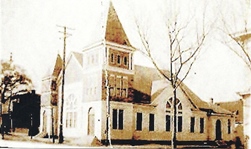
Several important things happened at this time: a picture of the church was sent to the Jamestown Exposition, the church was renovated and painted, and a parsonage lot was purchased. The Treasurer's report showed that all bills to date were paid leaving a cash balance on hand, and subscriptions for building a parsonage were being paid promptly. The second year of Rev. Whitlock's ministry was as active as the first. During 1908 the Ladies of the Church raised considerable money for the numerous needs of the Church and community. In June 1908, a series of revival services were held by Rev. Fred Day of Winston-Salem resulting in 28 additions. The minutes reported the work of the Pastor for the month of July 1908, in which Mr. Whitlock made 65 pastoral calls, held 28 services, and received 19 into the church, 12 by baptism. Rev. Whitlock resigned in the Fall of 1911.